Showing posts with label whiskey. Show all posts

Thursday, October 18, 2012

Cocktail Wednesdays: The Derby Cocktail

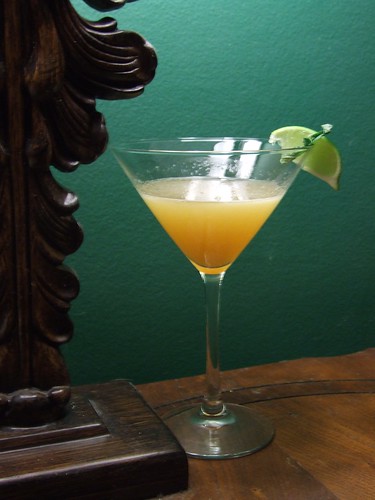
Derby Cocktail

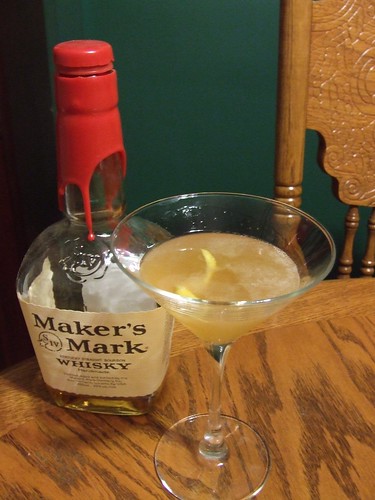
Last week, I settled on the Derby cocktail, trying to make something of the last mint in the garden, which in retrospect was rather shabby, as you can see from the photo.

Derby

1 oz Bourbon
1⁄2 oz Sweet vermouth
1⁄2 oz Orange Liqueur
3⁄4 oz Lime juice
1 lf Mint (as garnish)
1 wdg Lime (as garnish)

Shake over ice, strain into a cocktail glass, garnish with mint and lime wedge.

The verdict: I thought that it was a fairly straight forward, nice twist on a sour, with the orange note, and with a bit of extra spice from the higher rye content in the Woodford Reserve bourbon we chose. Scott liked it, but our guest did not. Then again, our guest also noted that he is not much of a fan of bourbon. Personally, I suspect it is the rye-heavy aspect he doesn't particularly like, since he has enjoyed other bourbon drinks in the past, made with other brands of bourbon.

Monday, October 8, 2012

Cocktail Wednesdays: Wild Flower

Wild Flower Cocktail

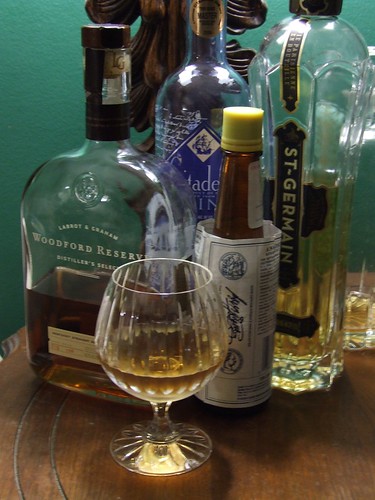
It has turned colder here, and on Wednesday, I broke out the Woodford bourbon for a more spicy and warm cocktail.  Flowers were a bit of a theme for the night, since I also fried up some cheese-stuffed squash blossoms for dinner, so I ended up selecting Wild Flower for the night's cocktail.

Wild Flower:

1 oz     Gin
1⁄2 oz  Elderflower liqueur, St. Germain
1⁄2 oz  Bourbon
1 ds     Angostura Bitters

Stir with ice, strain into a large snifter.

The verdict: This drink was an interesting progression of flavors.  Rather than appearing all at once, we felt that taste began with the gin, them moved to the bourbon, and finished with an elderflower aftertaste.  One of our guests was particularly fond, and I liked it, but Scott was not much of a fan.  He said he preferred the other elderflower drinks we had tried.

B. Nektar Cherry Chipotle Mead w/ Chocolate Cake

Our friends brought over something else for us to try - a special limited edition mead from their excursion to the B. Nektar Meadery.  The brand is made in Ferndale, MI, just outside of Detroit, and we had a great time at their anniversary festival last year. This particular mead - Cherry Chipotle - is quite unusual, as they added cherry juice to the honey before fermentation, and steeped it in chipotle peppers after fermentation.  As the bottle recommended, we paired it with a chocolate cake, and it was a lovely, smokey, spicy combination.  I felt that it tasted more like a spicy cherry wine than a mead.

Thursday, September 27, 2012

Cocktail Wednesdays: The Incredible Hulk and Black Hawk Cocktail

The Incredible Hulk Cocktail

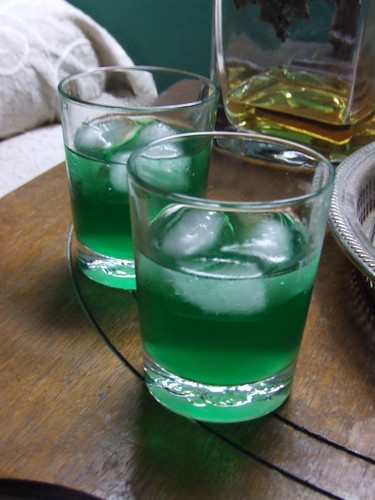
Yesterday, The Avengers movie was released on DVD, and several friends came over to watch it at our house. One requested an Avengers themed drink, so we tried The Incredible Hulk, though we halved the recipe, since we didn't have much Mountain Dew on hand.

The Incredible Hulk

2 oz Captain Morgan's Spiced Rum
1 Tbsp Sugar
Mountain Dew to top

Add the Captain Morgan to a glass with sugar, then add Mountain Dew until the mix turns green.

The drink wasn't going to be able to turn green with the amount of Mountain Dew we had, so Scott added a drop of green food coloring.

The verdict: Mountain Dew is already pretty sweet, so adding sugar made it even sweeter. Still, Scott and our friend liked it. Scott said, "it was weak and delicious." It was very sweet and had a totally different taste from its components. He couldn't really taste the Mountain Dew, though he could identify the flavor of the rum, weakly.

Black Hawk Cocktail

Personally, I am allergic to caffeine, so I didn't try that one. Instead, I had another cocktail, the Black Hawk Cocktail.

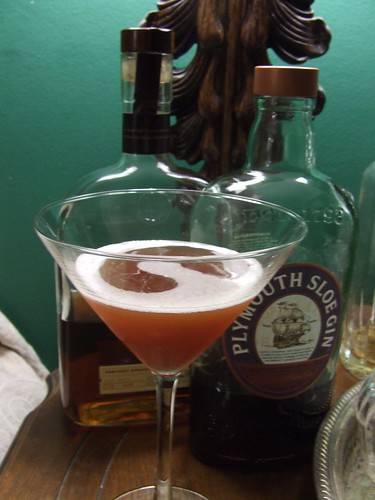
Black Hawk Cocktail

1 1⁄4 oz Bourbon
1 1⁄4 oz Sloe gin
1⁄2 oz Lemon juice

Shake over ice, strain into a coupe.

The verdict: The dominant flavors were the sloe gin and the citrus. I actually used half lemon and half lime, but it was still too acidic for Scott. The drink is very tart. Our friend felt it was too sour for him. I would definitely say that it is primarily sour with a back note of the plum-like sloe berry and some of the astringency of the gin. I do get some of the bourbon flavor, but it is fleeting. I think it's more identifiable in the aroma. Personally, I think this drink would be better with less lemon juice, less sloe gin, and more bourbon.

Thursday, September 20, 2012

Cocktail Wednesdays: French Manhattan

French Manhattan

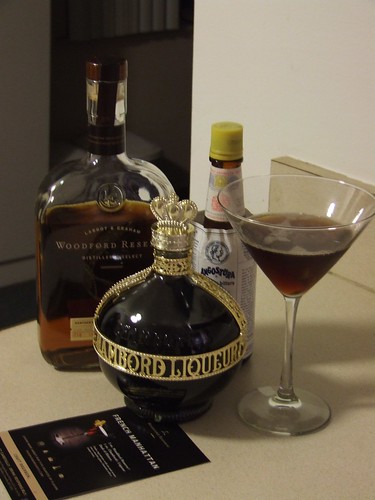
We picked us some recipe cards at the Woodford Reserve gift shop, and decided to try one today, the French Manhattan.

French Manhattan:

2 oz Bourbon, Woodford Reserve
1 oz Raspberry Liqueur, Chambourd
1 Dash Bitters

Shake over ice and strain into a martini glass. Garnish with a lemon twist.

The verdict: We all thought it was tasty. A fruitier twist on the Manhattan, with the Chambourd serving as the replacement sweetener in lieu of sweet vermouth.

Bourbon Distillery Tour: Woodford Reserve

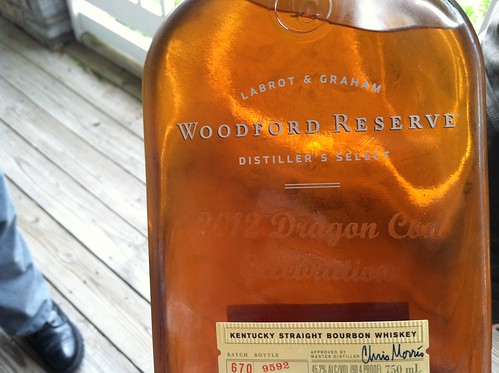
Woodford Reserve
A friend took advantage of the custom engraving in the gift shop.

Every year for the last three years, we've gone on a tour of a bourbon distillery in Kentucky every year for the last three years.  This year, our trip took up to the Woodford Reserve Distillery.
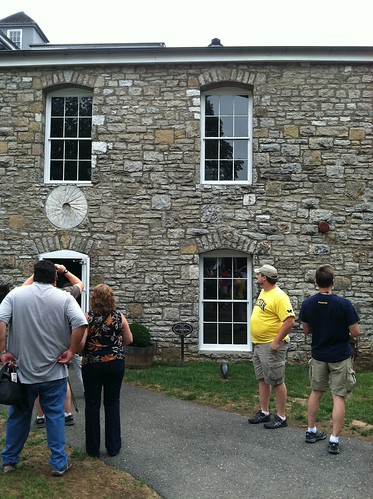
Woodford Reserve
Outside the distillery building

 At Woodford, they use the original limestone buildings erected by Scotch-Irish immigrants who originally owned the farm.  Inside this building is the distillery.
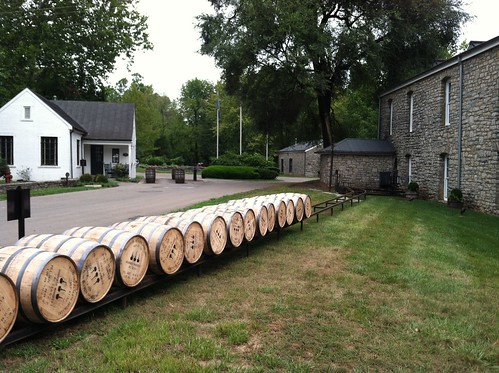
Woodford Reserve
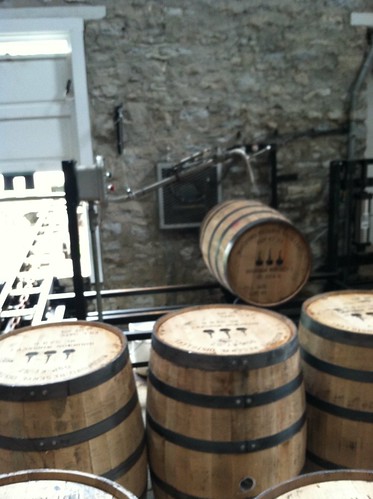
Barrel run with newly filled barrels

Barrels are transported between buildings on a barrel run, which is a sloped set of iron rails that runs between buildings, allowing them to roll easily along the track.  These barrels have just been filled at the distillery and are being stacked up, ready to go into the storage warehouses when enough have been filled.
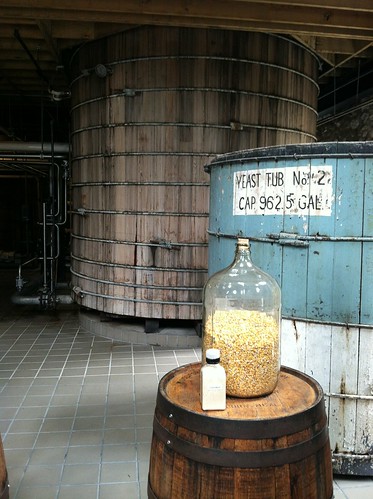
Woodford Reserve
Grain sample on display

During the tour, they told us about the exact proportions in the grain mix they use, which is high in corn and unusually high in rye, with only a small amount of malted barley.  The grain arrives as whole kernels, and they hammer mill it to the course grind shown in the smaller sample.  A hammer mill provides a result more similar to stone grinding than a roller mill used in most modern bread production, because it preserves the germ and therefor the majority of the nutrients and a lot of the flavor in the grain.

Woodford Reserve
Mash-tun interior

They use cypress tanks (made from Georgia cypress!) with chilled water cooling coils for their mash-tuns.  You can see the exterior of this mash-tun in the background of the photo above this one.  Cypress is used because of its resistance to water and its dimensional stability when wet.  They should get decades of use out of these tanks.

Woodford Reserve
Bubbling mash/wort/distiller's beer

Woodford uses a sour mash, which means that, like a sourdough, they reserve some of the previous mash to help start the next batch.  This helps consistency between batches, and I imagine that it is similar to sourdough, where good bacteria produce stronger flavors if you let them munch away for longer. If I remember correctly, they also pitch yeast into the mash in addition to the starter.

Woodford Reserve
Mash cooker
In the mash cooker, the grains are combined with hot water .
Woodford Reserve
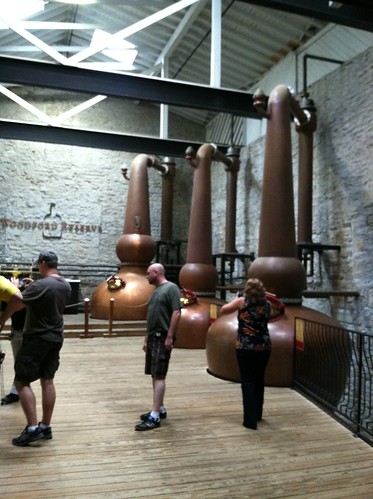
Copper Pot Stills
The bourbon is tripple distilled in three copper pot stills. The three stages are called beer, low wine, and high wine.  Most bourbon distilleries use column stills because they are easier to use for high-quantity production, but pot stills are known for the high quality of the liquor they produce.
Woodford Reserve
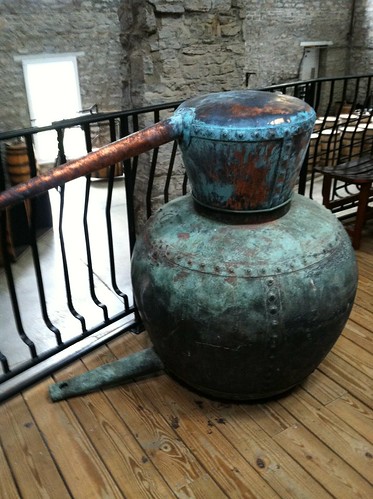
Original copper pot still from the property
Even so, today's huge pot stills are a lot more efficient for production than this tiny old one used by the farm settlers.
Woodford Reserve
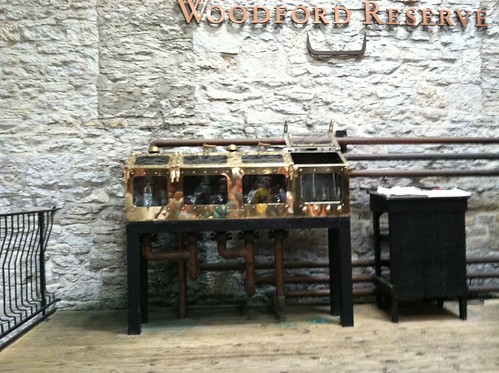
Spirit safe used to test the alcohol content of the distillate.
The master distiller will open this spirit safe to check the proof of the product at the different stages of production.  You can see the distillate pouring from the pipes as you stand next to the safe.  During prohibition, the distiller would have had a key and the government officer would have had the other, and they would have both needed to be there in order to open this safe.

Woodford Reserve
Modern copper pot still in use as the beer still
This still provides the first level of distillation.
Woodford Reserve
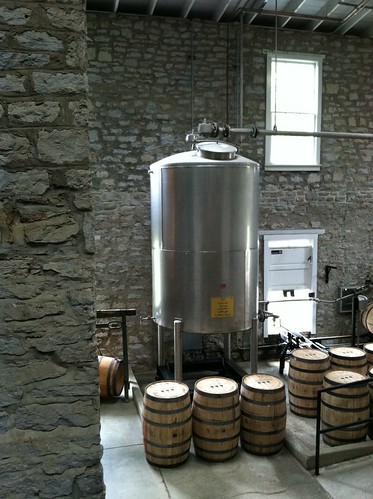
Tank used to dilute the spirit to the proper strength for barreling.
The proof of the spirit going into the barrel is regulated by law, and this tank is used to adjust the spirit coming out to the final distillation to the proper strength.

Woodford Reserve
Barrels with various levels of use and char

Here you can see how the oak barrels are transformed for and by the bourbon aging process. From left to right, we have new oak, toasted oak, charred oak, used barrel.  Bourbon barrels must, by law, be made from white oak, and never have been used before.
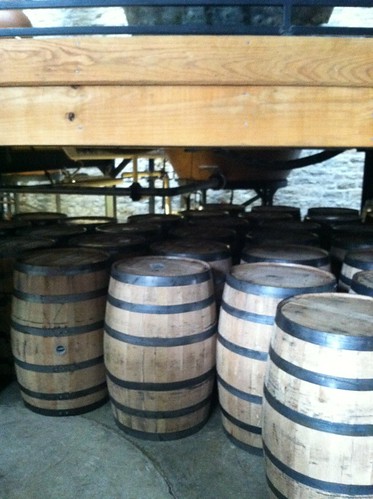
Woodford Reserve
Extra barrels ready to be filled.


Woodford Reserve
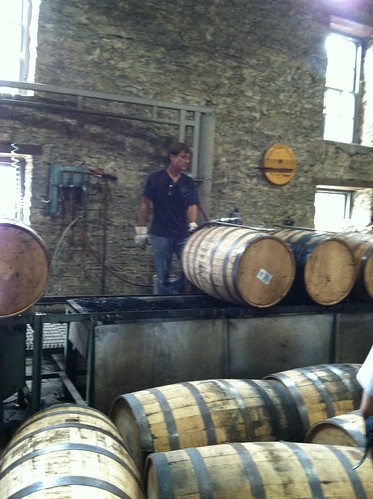
Barrels are filled individually
The horizontal cask is set up for filling, resting on a scale attached to the barrel run.  The distiller mans the spout as spirit pours into the barrel, until it reaches the proper weight.  Then he plugs the hole with a bung made of poplar, because this soft wood will not contract as fast as oak, ensuring a good seal. Then he rolls it down the barrel run toward the warehouse for aging.
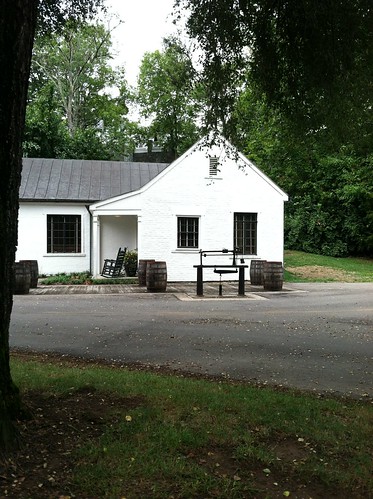
Woodford Reserve
Old scale and office.

Old scales like this one were originally used to gauge the value of a barrel of whiskey.  Older barrels actually weigh less, because water is lost during the aging process.

Woodford Reserve
Aging warehouse

Like the distillery, the aging warehouse is made of limestone in the Scotch-Irish vernacular style.
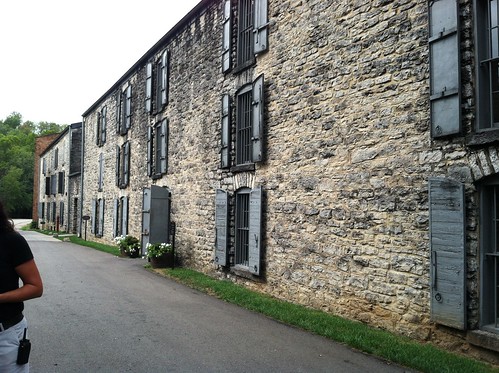
Woodford Reserve
Aging warehouse

Woodford Reserve
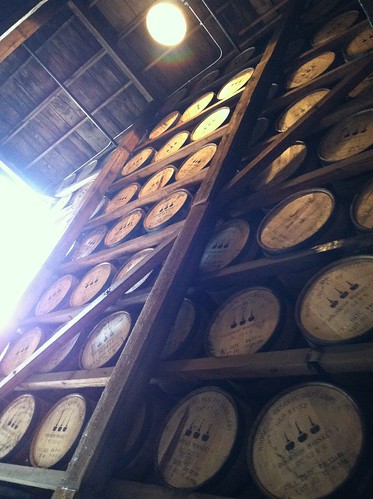
Stored barrels aging

Woodford Reserve
Barrels of aged whiskey being emptied
As the whiskey is poured out into this trough, small lumps of charcoal from the interior of the bottle loosened during the aging process also pours into the trough and is caught by a sieve.  Whiskey is then diluted to the proper proof before heading to the bottling line across the room.

Woodford Reserve
Bottling line

On this small bottling line, some things are still done by hand.
Thursday, July 5, 2012

Cocktail Wednesdays: Explosions In The Sky Cocktail

Explosions in the Sky Cocktail

This week's cocktail, Explosions in the Sky, was chosen in reference to our traditional way of celebrating the birthday of our country - with fireworks. The original recipe called for white whiskey, but we chose to use bourbon, which is uniquely American, and goes well with the Vernor's ginger ale we used.

Explosions in the Sky

2 oz Bourbon
½ Lime, quartered
10-12 Mint leaves
½ oz Simple syrup
3 oz Ginger beer or ginger ale

Add lime wedges, mint leaves, simlple sugar to a glass. Muddle. Add whiskey and stir. Fill glass with ice. Top with ginger beer or ginger ale. Garnish with a sprig of mint.

The verdict: This is a lovely drink, refreshing and minty, but a spicier variation of a mojito or a mint julep. Scott finds it preferable to a mint julep, but not as good as a mojito (which is one of his favorites). I don't think I would say the same, but rather, that it has to do with whether I'm looking for something spicier and richer.

Thursday, June 28, 2012

Cocktail Wednesdays: Caterpillar & Duck Under Cocktail

Caterpillar Cocktail
The Caterpillar Cocktail
Last week, we had a red table wine with dinner that was made from concord grapes.   Even though it had a normal alcohol content for wine, it still tasted like grape juice.  We decided that although we didn't like it as wine, we could try to use the rest of it in cocktails as a substitute for grape juice.  That is how we ended up trying the Duck Under and the Caterpillar Cocktails.

Duck Under Cocktail

1 oz Gin
1 oz Orange Liqueur
1 oz Grape juice

Shake over iced and strain into a cocktail glass.

The verdict: This was a pretty decent cocktail. We're starting to come to the conclusion that gin+citrus+fruit works well. Still, it wasn't particularly special, and we decided to go ahead and try another cocktail from my list once out guests showed up.

Caterpillar

2 oz Bourbon
1 oz Grape juice
1-2 dashes Angostura bitters

Shake over iced and strain into a cocktail glass.

The verdict: We liked this bourbon-based combination much more than the Duck Under Cocktail. It is a little sweeter than a Manhattan, and it's missing some of the spicy notes, but that makes sense, because you're essentially substituting the sweeter grape juice (or sweet concord grape wine) for sweet spiced and fortified wine. Given that grape juice and even the wine we were using have lower alcohol contents than vermouth -- which is fortified with additional spirits -- and it contains less whiskey, this is a less alcoholic twist on the Manhattan.

Wednesday, April 25, 2012

Cocktail Wednesdays: Tipperary Cocktail (No. 1)

Tipperary Cocktail (No. 1)

The Tipperary Cocktail has several incarnations, with extremely wide variations.  I started out looking to confirm the ratios given on Intoxicology, and came across an entirely different cocktail, which sounded even more appealing.  Apparently, early cocktail books list one or the other, and the Savoy Cocktail Book lists both.  Apparently, I need a copy of this book as I find myself frequently using Harry Craddock's recipes.   Although I have seen different ratios for the drink listed by Craddock as Tipperary Cocktail (No. 1), I decided to first try the original recipe, which is also the easiest to make, since it calls for equal parts of all of the ingredients.  Still, I am intrigued by other ratios, and most especially by the inclusion of scotch per Erik of Savoy Stomp.

Tipperary Cocktail (No. 1)

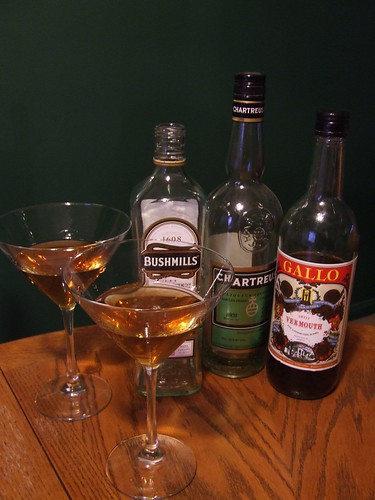
1 oz Irish Whiskey
1 oz Green Chartreuse
1 oz Sweet Vermouth

Stir over ice and strain into a cocktail glass.

The verdict: We both liked this one.  Scott felt that it resembled something we had tried before, and I think that is because the Chartreuse is the primary flavor.  Still, it plays nicely with the Irish whiskey.  Scott says, "It's a good mix."  I found that the vermouth primarily provided sweetness, and rounded out the drink nicely.  Scott wasn't even sure he could identify the vermouth, just that there was something providing the sweetness.  I think this is a cooler weather drink, as it is warm and rich along with the herbal notes.

Thursday, March 29, 2012

Cocktail Wednesdays: The Duppy Cocktail

The Duppy Cocktail

Last night's cocktail was The Duppy Cocktail, another offering from the Savoy Cocktail Book, chosen mainly because it seemed like something a little more suited for cold weather, and we're nearly out of that for the year.

The Duppy Cocktail

3 oz Irish Whiskey
1 oz Orange Liqueur
2 Dashes Orange Bitters
2-6 Whole Cloves

In a mixing glass, add cloves to Whiskey and let sit for about an hour.
When ready, add other ingredients.
Shake over ice and strain into a coupe.


The verdict: It was a lovely autumnal drink that started a little strong, but left you looking for more at the bottom of the glass. Scott and I both felt it reminded us of something we couldn't place. I imagine that this is why the Duppy Cocktail is apparently unusual - it takes an hour's steeping to make, and if you can get that flavor profile elsewhere, that's what you would do. I left some cloves in the final drink, as a sort of garnish, but it really didn't work -- some floated, some sunk, it just looked silly. Decorating an orange twist with them is definitely the better, lovelier choice.

Thursday, March 15, 2012

Cocktail Wednesdays: Ward Eight

Ward Eight

The Ward Eight was the drink I chose this week because, among my options, it was the one that seemed most classic, as I have seen many variations on it.  The drink comes from just before the turn of the century,  from Boston, and its districts called wards.  Per Savoy Stomp, "Rumored to have been created at the Locke-Ober (the second oldest restaurant in Boston) to celebrate the victory of Martin Lomasney’s 1898 campaign for a seat representing Boston’s Eighth Ward—a celebration that suitably took place the night before the election—the Ward Eight is a simple twist on a whiskey sour."

Ward Eight

1.5 oz Rye Whiskey
0.75 oz Lemon Juice
0.75 oz Orange Juice
1 tsp Grenadine

Add all ingredients to a mixing glass
Shake with ice and strain into a cocktail glass, garnish with an orange.

The verdict: We enjoyed this very orangey drink, possibly because I made it with fresh orange juice.  The primary flavors were orange and the rye. The lemon added tartness, but didn't overpower the orange juice or make Scott think it was too lemony.

Thursday, December 8, 2011

Cocktail Wednesdays: The Scofflaw

The Scofflaw

In honor of this past Monday's anniversary of Prohibition repeal, this week's cocktail is The Scofflaw.

To quote The Cocktail Spirit with Robert Hess:

It was in 1923, when Delcevare King, a member of the Anti-Saloon League, posed a contest to create a new word in order to combat the continued drinking which was going on during American Prohibition. The new word was to be one "which best expresses the idea of a lawless drinker, menace, scoffer, bad citizen, or whatnot, with the biting power of 'scab' or 'slacker.'" The $200 prize elicited a huge response. On January 16th, 1924, the Boston Herald announced the winning word as "scofflaw", with the winnings shared by the two Boston area residents, Henry Irving Dale and Kate L. Butler, who both submitted it. This was not the end of the story however, in just a little over a week, a salvo was launched from Harry's New York Bar in Paris, where they created a new drink and christened it the "Scofflaw".

Those of us Americans who enjoy an old-style cocktail have something to thank those scofflaws for, and the drink is a good one to celebrate the repeal of prohibition. I find it interesting to note that the word has come to mean "A person who flouts the law, esp. by failing to comply with a law that is difficult to enforce effectively." as per the Google dictionary. What strikes me about this current definition is that the word is now a critique of the law as well as the law-breaker. World Wide Words defines it as "A person who flouts a law, especially an unsustainable one," and says "it often refers to persistent offenders against parking laws and other minor regulations." Not all dictionaries make this distinction between the meaning of scofflaw and criminal wherein the law in question is criticized, however I find the distinction to be a marked critique of Prohibition and of other current laws that they would be equating to Prohibition.

After looking at a number of recipes, I chose to use the one Kenn posted on Cocktailia, which follows what appears to me to be the most typical ratio of rye to dry vermouth, most typical amounts of lemon juice and grenadine and also includes orange bitters, which is always included in the recipes with slightly different ratios. I also included a lemon twist, which frequently appears in the recipes.

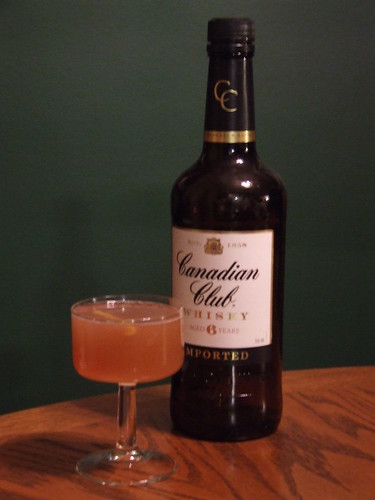
The Scofflaw

1 1/2 oz Rye whiskey
1 oz Dry vermouth
3/4 oz Lemon juice
3/4 oz Grenadine
2 dashes Orange bitters
1 Lemon twist (garnish)

Shake over ice and strain into a chilled cocktail glass. Garnish with a lemon twist.

I chose to use Canadian whiskey, rather than American rye because I was reading that this was likely what was used during Prohibition when this drink was invented. Canadian whiskey is historically referred to as rye whiskey, though unlike American rye, it has no legal definition of rye percentage. Per Wikipedia "Historically, in Canada, whisky that had some rye grain added to the mash bill to give it more flavour came to be called “rye”. Although many Canadian whiskies are still labelled as “rye”, the modern mash bill for a Canadian “rye” whisky often contains little or no rye grain, and their flavour is derived in other ways (such as flavour development from the aging process, blending with stronger-tasting Canadian whiskies, and the addition of flavourings)." On the other hand, American rye "is, by law, made from a mash of at least 51 percent rye." Under Canadian law, "rye whiskey" and "Canadian whiskey" are synonymous, so a drink made during prohibition was most likely made with Canadian whiskey.

Canadian Club seemed particularly appropriate given its popularity here in Detroit, where many scofflaws ventured across the Detroit River in rowboats or over the winter ice pack in cars to bring it back from Hiram Walker Distillery in Windsor, Ontario. The same laws and the same geographical situation that led Hiram to move from Detroit to Windsor to establish his distillery ironically led to the prominence of The Purple Gang, and the national dominance of Detroit as a liquor-smuggling port. This dominance was supported by the burgeoning auto industry and the suped-up cars that savvy Detroit gangsters were able to have built for their rum running. Anyway, back to it.

The verdict: I think I may have been a bit heavy-handed with the orange bitters. I think the orange overtook, with the red fruit of the grenadine close behind. It seemed a bit like a boozy version of those pea-sized powdered-sugar-dusted hard candies that came in round white tins when I was a kid. I don't remember what they're called, but that's what it made me think of. I can think of a number of people who would like it just as-is, but as for myself, I would try it with a more pungent American rye or dial back on the lemon juice, grenadine and orange bitters. Of course, part of this may be that my grenadine is rich simple syrup, rather than 1:1, which I am starting to suspect is more common.

Thursday, October 20, 2011

Cocktail Wednesdays: The Buster Brown

Buster Brown Cocktail

Yesterday, spent the afternoon and early evening priming the ceiling in the basement (not to mention a few walls before that), and by the time Scott got home, I was ready to collapse. I didn't have the energy to cook the meal I had thawed ingredients for, and I hadn't picked a cocktail either. Scott sweetly took care of everything, but not a cocktail. Tonight, on the other hand, I felt up to trying something. I picked something with lemon, since Scott wasn't having a cocktail with me; he just had a glass of whiskey. This Cocktail Wednesday Thursday's drink of choice was the Buster Brown.

I can only assume that the Buster Brown is named after the cartoon character, but I can't confirm that, and there are also other candidates in a blues singer and a baseball player. It is a twist on the whiskey sour. The Buster Brown has 25-50% less lemon juice, and it adds the aspect of orange bitters.

The Buster Brown:

1 1/2 oz Bourbon
1/2 oz Lemon juice
1/2 oz Simple syrup
2 ds Orange bitters

Combine all ingredients and shake over ice. Strain into a cocktail glass. Garnish with the lemon twist.

The recipe I used came from a new favorite resource of mine, Kindred Cocktails. I found this website through a comment on my misguided first attempt at the Colony Cocktail. Not that we've tried a second attempt yet, but we do know what real maraschino is now! At any rate, the reason I find it useful is that you can not only search and filter recipes by ingredient or recipe name, but you can also create a "Cocktail Book" of recipes you like or want to try, and you can rate drinks. You can create categories within your cocktail book, and you can print a menu with recipes. Some other Buster Brown recipes I found while trying to find something on the history of the drink have less syrup or less lemon juice. The recipe on the Cocktail Database uses sugar rater than simple syrup, and the recipe on Vintage Recipes uses gum syrup. Personally, I'm a bit curious as to what the results would be it I substitute syrop de citron, ad if this is something I could try routinely for Scott to bring down the acid level in drinks with lemon. Then again, he might be able to handle the reduced quantity of lemon in this drink.

The verdict: Personally, I find this much nicer than a typical Whiskey Sour. The orange bitters add a surprising amount of orange flavor for such a small quantity, and it balances fairly equally with the lemon. The bitters add depth to the drink as well, in a way that orange juice would not. Perhaps it could use more whiskey and/or less simple syrup, but I did like it.

Thursday, September 29, 2011

Cocktail Wednesdays: Fancy Free

Fancy Free

This week's cocktail was The Fancy Free. I found it thanks to tooling around on Kindred Cocktails looking for drinks that involve orange bitters. I found Kindred Cocktails thanks to a new comment on my Colony Cocktail post, from back when we didn't know the difference between Marachino cherries and real Marachino liqueur. We still have to retry the Colony Cocktail, but we've had to throw out the grapefruit juice we had, and I'm trying to use things we have first. The Fancy Free was a great candidate for a new drink we could make without buying anything.

Fancy Free

2 oz Bourbon
1/2 oz Maraschino Liqueur
1 ds Angostura bitters
1 ds Orange bitters

Stir with ice and strain into cocktail glass

The verdict: Both Scott and our guest who tried it liked it so much that they thought they would order it out at a bar. I call that success. The Marachino took center stage for me, but it still combined really nicely with the other elements.

Thursday, September 8, 2011

Cocktail Wednesdays: James Joyce

James Joyce Cocktail

Last night's drink was the James Joyce. The cocktail is, as you might imagine, an Irish whiskey based cocktail. Personally, thinking of the Irish author James Joyce makes me think of Finnegan's Wake. I've never read the book, but I do know the Irish street ballad that inspired it. In the ballad, when whiskey spills over Tim Finnegan's apparently dead corpse, he wakes up. The word whiskey comes from the Gaelic words for water of life, which James Joyce apparently found fascinating in the context of this ballad.

Of course, the cocktail isn't just a glass of whiskey. It's a sour, which appears at it's base in the Whiskey Sour, which is whiskey, citrus (lemon or lime) and sweetener. More specifically, the James Joyce is a New Orleans Sour, which means that the sweetener is an orange liqueur rather than something non-alcoholic, such as simple syrup or runny honey. We've already tried one, the Sidecar, and you're likely familiar with another, the Margarita.

James Joyce Cocktail

The James Joyce:

1.5 oz Irish Whiskey
0.75 oz Sweet Vermouth
0.75 oz Orange Liqueur
0.50 oz Lime Juice

Add all ingredients to a mixing glass
Shake with ice and strain into a coupe

The verdict: We both liked this a lot. The vermouth presence was very low, and it took a back seat to the other flavors, but I do think it adds some depth of flavor. Since Scott's favorite two spirits are Irish Whiskey and Grand Marnier, this was a good combination for him. Also, the lime seems to be less acidic and more palatable for him. That makes this drink another good step in figuring out what will be more likely to work for us.

Thursday, July 14, 2011

Cocktail Wednesdays: Butterbeer

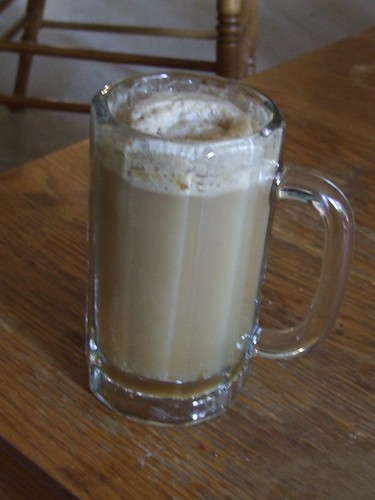
Butter Beer

In honor of the release of Harry Potter and the Deathly Hallows: Part 2, this week's drink was butterbeer. I used the recipe from this week's Working Class Foodies episode featuring the drink. Now, butterbeer as described in the books, is only mildly alcoholic, and the WC Foodies version is completely non-alcoholic, though they suggest adding a shot of bourbon if desired.

Butterbeer:

3 Tbsp Butterbeer Syrup (see below)
Seltzer Club Soda
2 oz Bourbon (optional)

To a tall mug, add Butterbeer Syrup, bourbon (if desired), and top with Seltzer Club Soda.

Butterbeer Syrup:

3/4 cup Brown Sugar
2 Tbsp Water

5 Tbsp softened butter
1 Tbsp lemon juice
1 Tbsp vanilla
1/2 tsp salt

1/4 cup heavy cream

Add brown sugar and water to a small saucepan and heat over medium high heat. Stir constantly. Keep a glass of water to the side for dipping your spoon or heat-proof spatula in. Bring to a low boil and remove from heat when candy thermometer reads 240ºF. Stir in butter, vanilla, salt and lemon juice. Once these are incorporated, add heavy cream, mix and let cool.


(Image of Emma Watson and one of the Phelps twins drinking butterbeer at Universal Studios from here)

The verdict: The syrup is amazing, similar to butterscotch or caramel, but with a beautiful tang from the lemon juice that keeps it from being too cloying. The first reaction to the finished drink from everyone else was how strong the whisky taste was, but I wasn't so sure. I felt that the sharpness was actually from the seltzer in the original recipe. I tried adding more syrup, and that made it better, but I still felt that you could barely taste the syrup and I wasn't enamored. I tried another using club soda rather than seltzer, which I thought was much smoother. The sweet flavor came out much better, even with the original syrup quantity, and the taste of the whiskey was not strong. Still, I'm not satisfied.


(Butterbeer movie still found at Homebrewtalk.com.)

As you can see, the color and texture matched neither the theme park version nor the movie version shown above. Particularly unappealing about this version of butterbeer is the head, which does not dissipate, but floats on the top like some kind of buttery foam or scum. It's not bad tasting, but it's a very strange texture, and would be better if it were lighter, like the head on beer. Butterbeer should be able to be served hot as well as cold, and I can't imagine this one hot. I suppose I was expecting something closer to hot buttered rum, but with more foam. (On the other hand, the hot buttered rum shown here looks just right.) According to Wikipedia, the drink served at Universal Studios is very similar to cream soda. Some butterbeer recipes include cream soda. Some butterbeer recipes and some hot buttered rum recipes contain less butter. I'm interested in trying other recipes. I wonder if we can convince our friend who loves to homebrew to try this one. We could also try this historical buttered beer recipe. I am also wondering if we could adapt a cream soda recipe to end up with better results. Interestingly, the original cream soda recipe used acid and sodium bicarbonate to fizz, but I think I like the idea of a yeast based soda better than either sodium bicarbonate or seltzer. A cream soda made with brown sugar does seem to have a good color and good potential, and I'm curious about what I'm reading about lactose sugar. Maybe butterbeer is yeast-based cream soda left to ferment a little too long? Anyway, lots of ideas to try.

Thursday, May 19, 2011

Cocktail Wednesdays: Vermontucky Lemonade

Vermontucky Lemonade

This week's drink harkened back, in some ways, to the other week's Mint Julep. It's another iced drink involving burbon. This one is a recipe from Deb at Smitten Kitchen, Vermontucky Lemonade. Vermont because it contains maple syrup, and Kentucky -- as mentioned -- for burbon.

In presenting it tonight, I tried to make it as a single serving, rather than making the lemonade and pouring it over the ice and burbon as Deb directs.

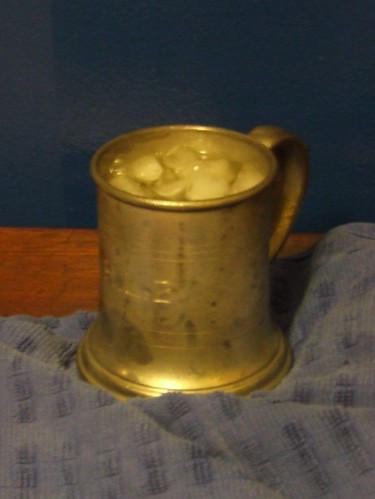
I served it in glass-bottomed pewter mugs that I received today in the mail from my mother. They once belonged to to my grandmother's uncle, who raced and trained horses on Long Island. A quick search on google, found me an article about when the National Steeplechase and Hunt Association granted his license to ride in the Steeplechase on January 11, 1910, two articles on races he won in 1911 and 1912, a race in 1918 in uniform, to the opening of the United Hunts Association in 1925, to a race he judged in 1938. I thought it was appropriate to use these mugs for a drink that I associated with horse racing, even if the association is just in my own mind.

Vermontucky Lemonade

Juice of one lemon
2 tsp Maple syrup
2 oz Bourbon
Ice (I crushed the ice a little in a bag with a mallet)
Cold water

Mix lemon and maple syrup until syrup is fully dissolved. Fill cup with ice, add burbon. Add lemon juice mixture. Fill with cold water to top and stir.

The verdict: Tasty and refreshing thumbs up from me and our guest. I found that the whiskey and maple syrup added a richness to the lemonade. Scott found it to be too acidic, and thought that it wasn't a standout for him.

I realized belatedly that the Preakness is happening this weekend, so next week's drink will be the Black Eyed Susan.

Thursday, May 5, 2011

Cocktail Wednesdays: The Mint Julep

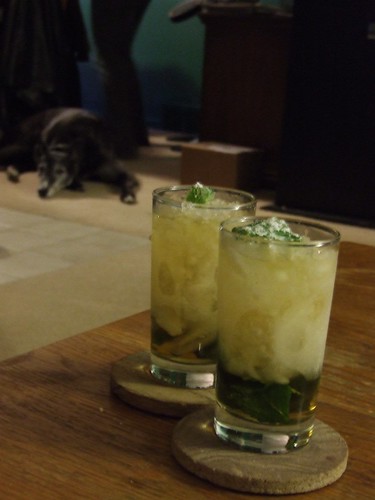
The Mint Julep

In honor of this weekend's Kentucky Derby, this week's drink was the Mint Julep.

The Mint Julep

2 oz Whiskey
1 oz simple syrup
A dozen leaves fresh mint
powdered sugar
A silver julep cup or collins glass

Muddle mint leaves in the simple syrup in the bottom of the glass until broken and the oils are released.
Add the whiskey. Stir it all together.
Fill glass overflowing with chipped ice.
Garnish with a sprig of mint coated in powdered sugar.

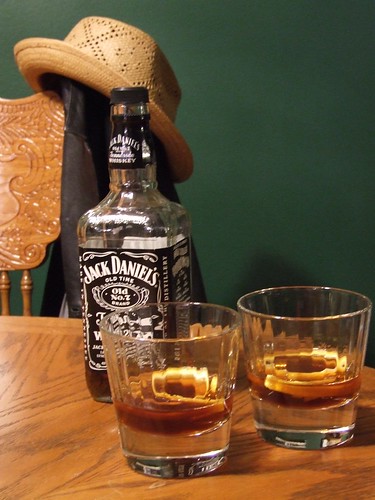
In my mind, the Mint Julep is so associated with Kentucky that it should be made with burbon, but we only had an ounce of Jim Beam bourbon left, and the only other burbon in the house is the Eagle Rare, which we won't be mixing drinks with. So, the for the rest of the whiskey, we used Jack Daniels as we have been using for other whiskey based drinks. Pretty soon, we'll have to move on to using up some of the other whiskeys in the basement bar.

Based on what I learned at the Buffalo Trace distillery, the differences between burbon and other whiskeys are as follows: 1) burbon is made in a certain area of Kentucky. This is significant because of the unique limestone hills there. The calcium in the limestone is taken up by the grass that the horses eat and that is what makes it such good country for raising horses that not only does the arguably most famous horse race in the world take place there, but many international horse owners stable their horses there during most of the year. The water contains the calcium and changes the flavor profile of the whiskey, just as the granite in Scottish highlands makes the difference between highland and lowland whiskey. 2) Burbon's primary ingredient is corn (maize). Grains typically used in whiskey are rye, barley, wheat, and corn. Changing which is the primary ingredient changes the flavor. Scotch malt whiskey is made primarily from malted barley. Using corn as the primary ingredient means that the whiskey is sweeter. 3) Bourbon must be aged in new, charred oak barrels. These barrels are often subsequently used by other distillers to age their spirits, including the majority of Glenlivet, Glenfiddich, and Glenmorangie single malts. 4) Burbon must be aged at least two years. If you're lucky, the stuff in the drinks gun is a toddler. The stuff not found on the bottom shelf is generally aged at least six years. See other technical information about the legal definition of burbon here. Actually, Tennessee whiskey meets the legal definition of burbon, and can officially be sold as such, but of course, it doesn't have the same water, and tends to use a special filtration process. At any rate, Tennessee whiskey is not a bad substitute for burbon.

Given the amount of water or melted ice, and the lack of a bitter component, the Mint Julep is more of a twist on The Sling than a cocktail. Apparently, as mentioned on 12BottleBar and in the video clip linked to below, juleps were originally ancient Persian drinks of herbs macerated in sugar syrup, and they were often used in more recent times for medicine delivery. It was here in the US in the 19th century that juleps were combined with alcohol, and the rest is history. Now, they are thought of as the perfect relief on a long, hot, Southern summer day.

Watch a master mix one up and recite poetry about it at the same time.*

Surprisingly, I had never tried one before, though I have had mojitos plenty of times since my first one years ago at Loca Luna, a tapas restaurant in Atlanta. The mojito recipe I have used is from fellow MyFolia gardener Mondomuse, from when I was super active there. (I still really like the site, there are just too many sites taking up my internet time, so I use it more sparingly.) The Mojito is similar to the Mint Julep in that it is a sweetened, iced, mint mixed drink. It is different in that it contains club soda and lime, and the spirit used is rum.

The verdict: All four of us at the table thought the julep was delicious. I think that the julep is a much more subtle drink than the mojito, and because the rum in the mojito is a white rum, it is a spirit with less flavor and character. The julep is, I think, a more interesting drink, even though it contains fewer ingredients. Despite the fact that it is rather diluted due to the ice, it doesn't taste weak. It doesn't seem to be common on menus, and I was afraid that it had been abandoned because of an old fashioned (in a bad way) flavor profile, but that isn't true at all. The mint goes beautifully with the sweetened whiskey. It is a really lovely drink.


*Ignore what the video says about the silver cup conducting the heat of the alcohol. Obviously, alcohol at room temperature doesn't have a different physical heat from the room, and even if it did, heating up a glass will not cause condensation on it. I suspect the trick of the silver cup feeling cooler is that it cools your hands and lips as their heat is conducted into the glass to melt the ice. Also, unlike glass, silver is reactive, so it may lend something to the flavor profile.

Thursday, April 21, 2011

Cocktail Wednesdays: THE Cocktail

The Cocktail

This week's mix drink was in many ways the one that started it all, The Cocktail. I believe I first heard about The Cocktail or Cock Tail from a Four Pounds Flour, the blog of a food historian that I follow. It was also mentioned by our tour guide at the Buffalo Trace distillery. Finally, reading about it on the 12 Bottle Bar made me decide that trying it would be a really good thing to try in order to give a little more structure to our efforts, helping us make sense of the new things we try.

THE Cocktail:

1 lump Brown Sugar
2 dashes Bitters
1 tsp Water
2 oz Spirit

Citrus Peel garnish.
A lump or two of Ice is optional.

Place the sugar cube in the bottom of double glass. Dash the bitters over the sugar and let them absorb. Add the teaspoon of water. Muddle this all together until the sugar is as dissolved as possible. Add the spirit (we used the whiskey we had on hand, but cognac is also recommended). Stir.

Before the invention of The Cocktail, the only mixed drinks were punches or slings. The basic theory behind the recipe for punch is: 1 part sour, 2 parts sweet, 3 parts strong, and 4 parts weak. The sling is kind of like a single serving punch, minus the sour, and stronger. Even though the sling is stronger, it still has half as much water as spirit. The Cocktail cuts down on the water considerably, and it adds the essential ingredients of the bitters. Bitters was the cure-all of its day, just the sort of thing that snake-oil salesmen were hawking. Like the Gin and Tonic, The Cocktail was put together as an enjoyable, alcoholic way to take your medicine. They never realized just how enjoyable it would make the drinks, but the rest is history. After that, other mixed drinks developed

According to the guide at Buffalo Trace, the Cocktail was named after the jigger used to mix it; before it was used for mixing drinks, it was used for measuring eggs, and its original name reflected that, giving its moniker to the drink.

The verdict: The Cocktail is good, and has an interesting complexity. We tried it both with and without ice. I understand why this caught on, especially in the early 1800s, when the quality of American spirits in many places would have benefitted by being part of a mixed drink. The Old Fashioned is a very similar drink, and it is probably an attempt to get a bartender to mix a Cocktail once the work cocktail came to mean generic mixed drink, just like Kleenex, Xerox, or Band-aid. The Cocktail is better than The Old Fashioned, though. I am all for championing the return of the original Cocktail.